


The True Meaning of Taurus
How the Bull's most ancient meaning will surprise - and empower - you

A necklace, tattoo, bumper sticker, most fans of astrology take their symbols for granted. But what does the ram, the bull, the twins, the crab… what do these symbols mean?
Even the highest caliber astrologers tend to take what they have been taught at face value. Aries means Y, Taurus means X, just because a formula has been tried and tested for thousands of years and has worked decently well, does that mean it is absolute truth?
What if there is a higher perspective that expands what’s possible through deriving a deeper meaning?
This is what I am questioning through exploring the mythology behind the zodiacal constellations.
What we find when we go looking will surprise us, and even turn our preconceived notions of what the stars and planets mean, on their head entirely. But if you can sit in the discomfort of the paradigm shift, you may just uncover a higher truth that brings you closer to yourself. This has always been the purpose of myth, and the stars, a way to remember and integrate these ancient stories on human and cosmic nature.
Taurus, where the Sun is today (6/19) and leaves tomorrow, is the symbol of the bull, one of the most ancient in antiquity, found on 27,000 year old cave walls and dominant throughout early civilizations, especially in the Mediterranean and Mesopotamia.
What is the most ancient meaning of the bull, the one our ancestors would have believed, the stories they told about this constellation for thousands of years?
At the deepest, most ancient essence, the bull is a symbol of the life-death-rebirth cycle. It’s about power we gain from our resurrection.
Yes, the bull, not the scorpion, is the most potent symbol of the deepest transformation.
Let’s begin with what the bull, and the sign of Taurus, is traditionally understood to mean in mainstream astrology.
While Google AI isn’t my favorite source, this list it generated about Taurus’ meaning is pretty comprehensive of what you’ll find in modern astrology:
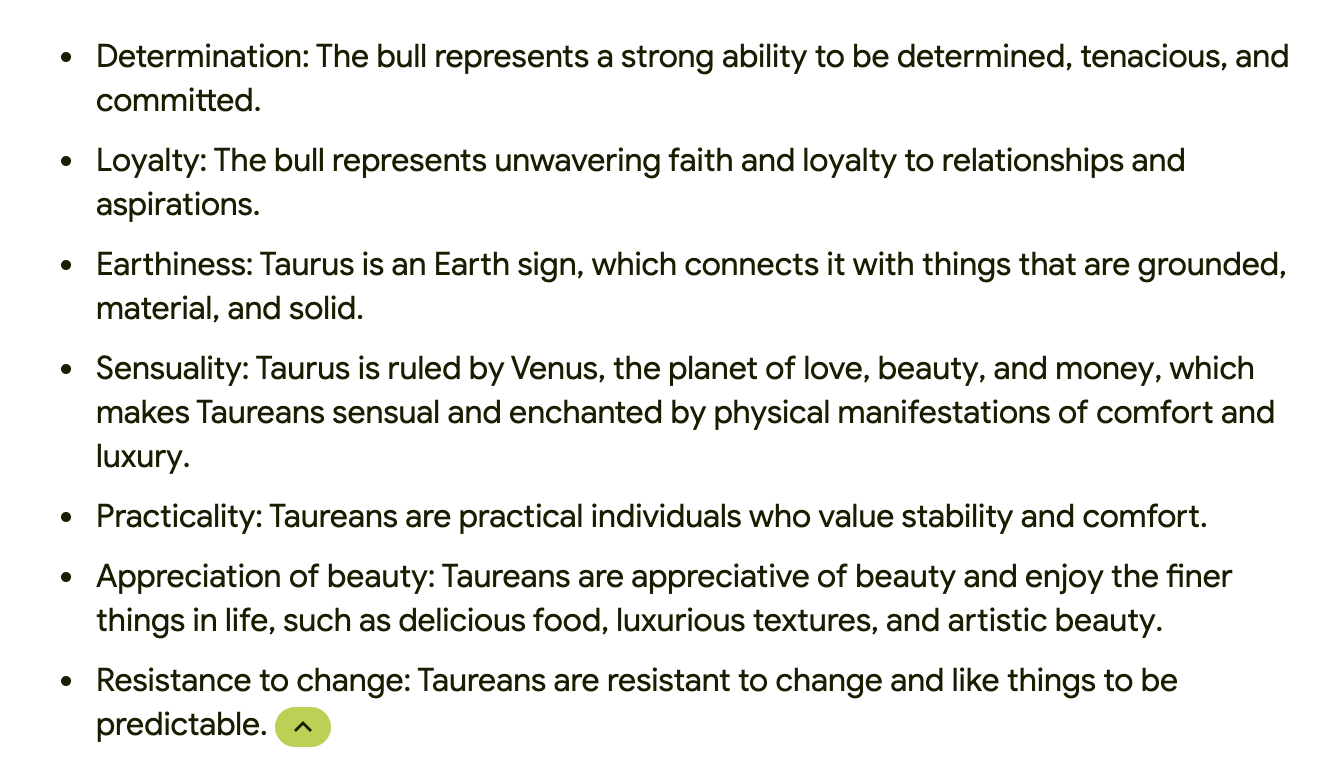
As you can see in hints here, a great deal of what Taurus means derives from two things: it’s ruling planet, Venus, and the associated element, Earth. I wrote in depth about how planets gain their ruling signs in this article - it’s more arbitrary than you might think.
If I open a favorite astrology book of mine, by Juliana McCarthy, The Stars Within You, to the page on Taurus, she calls the archetype of Taurus “The Sensualist,” the main descriptors “dependable and materialistic,” and the attributes “stable, patient, elegant, resourceful, security-oriented, and decadent.” She mentions the shape of the constellation, with the bulls’ face bending towards the earth, being aligned with its “slow and stubborn” nature and notes the animal itself is “large and sturdy.”
McCarthy goes on to talk about the myth of the bull Cerus, who was connected to Persephone, who was calmed by his presence and rode on his back. Masculine bull, feminine goddess, this is a tradition that transcends the Greeks, who’s stories were modern by antiquity’s standards.
This is exactly how the vast majority of inquiries into the root meaning of astrology falls short—most turn to the Greek myths as if these are the best or only interpretation of the constellations. By focusing solely on the Greek interpretations, we fall short of a full understanding of the energetics these constellations hold.
It’s essential to expand our investigation, further back in the timeline, and wider geographically, while taking into consideration the truth that the Greeks were a male focused culture known for disregarding and changing the myths of the goddess.
Bull = Transformative Power
The Bull is directly connected to one of the oldest, most pervasive, and powerful myths: the god, initiated by the goddess, who dies and is resurrected.
The attributes traditionally connected with the signs of Scorpio and Pluto, such as death, rebirth, transformation, and power are not linked by mythology to stories of the scorpion* as directly and clearly as they are to the bull.
Ultimately, the bull is about power— the personal sovereignty that is gained when we are willing to face our darkest shadows head on, bear the pain they might bring, and rise again on the other side of it all.
Taurus, when considering ancient history across thousands of years and miles, is the true holder of the archetype of death-life-rebirth.
Let’s dive into the ancient spiritual history that led me to this conclusion, including the original goddess Inanna, whom the bull is directly tied to.
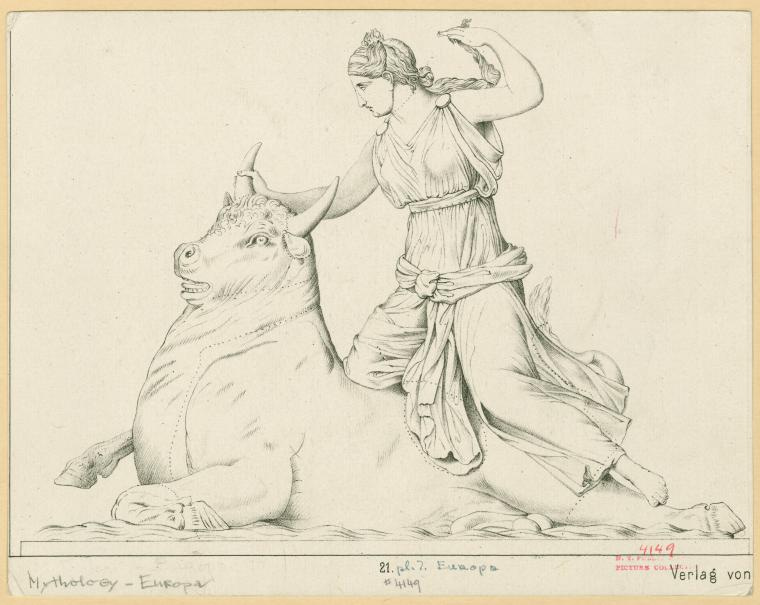
Likely Europa and the bull, a Greek myth, read more here.
The Bull & Death
Taurus is one of the brightest and largest constellations in the sky, and every culture had a story about the bull, and usually the “Seven Sisters” or “Pleiades” star cluster that sits within it too. One of the elements that made Taurus so important was its proximity to Orion, very often believed to be the most important constellation in the sky.
One of the oldest known cave drawings, dating back at least 40,000 years in Borneo includes a wild bull with horns. Scholars ask, is this just a hunting animal, a representation of the constellation, or a mark of a deeper spiritual culture? We cannot know, although scholars believe that Taurus (plus the Pleiades) is represented in the Caves of Lascaux in France that dates to 15,000 BCE.
In anthology on myth (my notes here primarily being from Mircea Eliade and Joseph Campbell) the bull is everywhere, very early.
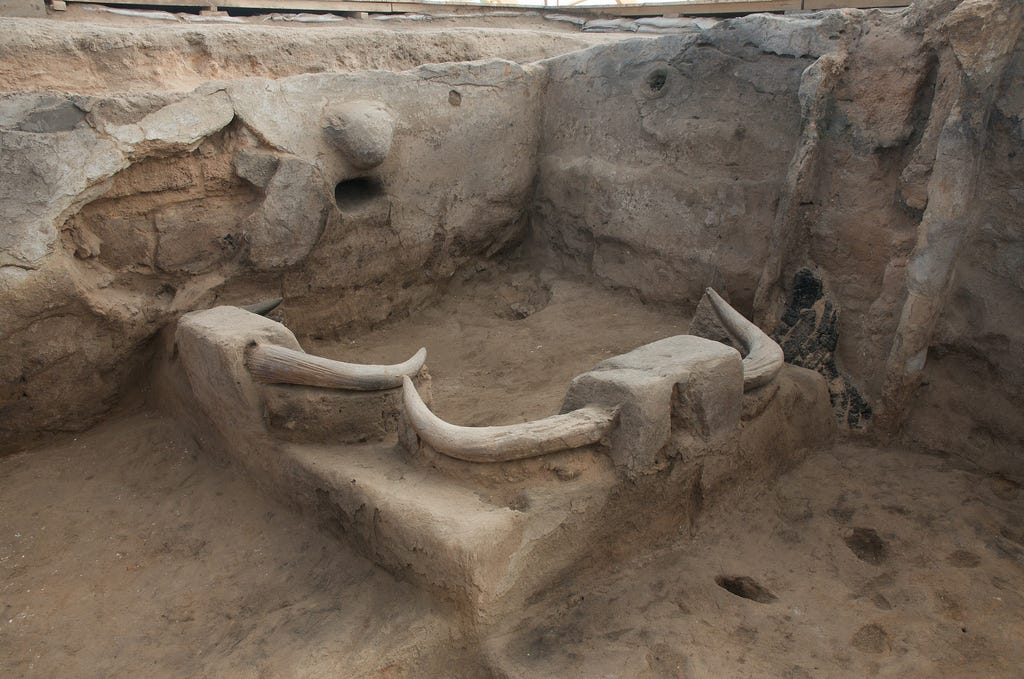
A decorated house platform at Çatalhöyük with bull horn installations and hand prints on the wall.
At Çatalhöyük in Turkey, a large Neolitic settlement that has been dated to 7500 BCE to 6400 BCE first discovered in 1958, the bull is central. A ceramic figure of the Goddess with arms and legs lifted in a “giving birth” posture and what does she deliver but the bull’s head, thought to be an association of the divine feminine’s role in birth - and rebirth.
Often at Çatalhöyük the bull horns are placed with human skulls or breasts below them, and vulture’s skulls and boars jaws within them. What this seemingly strange combination speaks to is death, with the pigs horns pointing down and the presence of the vulture, and resurrection - with the bull’s horns pointing upwards, and the presence of the goddess’ breasts.
James George Frazer in his work on mythology and ancient spiritual history, The Golden Bough, describes how the prime sacrifice in the old early kingships was the king himself. Later, the bull took the king’s place.
“One did not sacrifice female animals, as the female is not that which dies and is resurrected; she is that which carries death to resurrection—she is the transformer.” - Joseph Campbell
The royal tombs of Ur, in Sumeria, dating back to around 3800 BCE were discovered in 1922 contain the mass ritual death of Queen Puabi and her king. Yes, above her tomb are cylinders with no mention of her husband, indicating her primary position and although she was buried beside her husband, her court was interred above his. Little is known about the true circumstances of what happened in these royal tombs, except that most of the court - and possibly the Queen and/or King as well - went to death willingly. Sixty eight women lay down in unison in full ceremonial dress, arranged in elaborate positions adorned with jewelry and musical instruments, and never awoke.
To our modern mind, it is hard to conceive, but the ancients had an entirely different relationship with death, and the bull was central in the symbolism of the death-rebirth cycle.
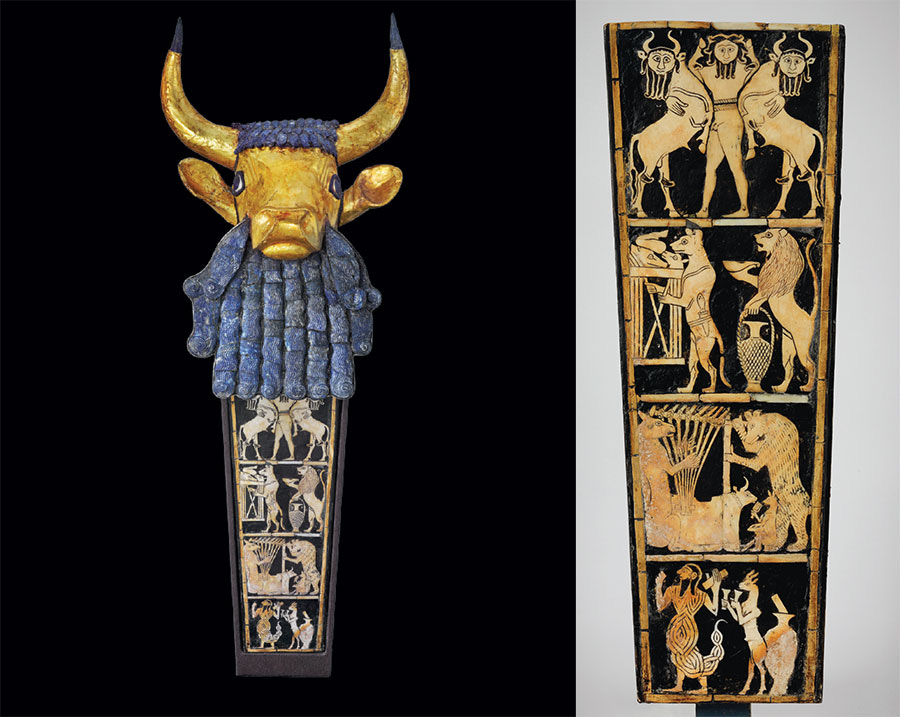
Above Queen Puabi’s body was a head of a cow in silver, and in the King’s chamber there lay harps with bull heads, covered in gold and lapis lazuli.
“The mythic lunar bull, lord of the rhythm of the universe, to whose song all mortality is dancing in a round of birth, death, and new birth, was called to mind by the sounds of drums, strings, and reed flutes of the temple orchestras, and those attending were set in accord thereby with the aspect of being that never dies.” - Joseph Campbell
The Moon Bull
Again and again in early antiquity, the bull is associated with the masculine, sacrifice, death, and the moon. Yes, the moon was masculine in prehistoric antiquity, and the sun feminine — this was directly related to the dominance of the goddess during this time.
Why was the sun feminine? In antiquity, the woman and the goddess as the creator through birth possessed the qualities of eternal life.
As I wrote in Origins of the Ancient Goddess, there was a time when it was believed that the woman conceived children within relationship to the earth itself. This is what we need to remember - ancient people did not have the understanding of biology that we do. Although they had brilliantly advanced wisdom we now lack in many ways, but this is an element of how and why the goddess was venerated as the source of life, solely.
If you follow this line of thinking, it begins to make sense why the male was associated with the moon, which “dies” for three days every month and is reborn again. The bull’s horn shape mimics that of the crescent moon, that sliver of light that precedes and follows those three dark days where the earth casts its shadow.
The man “dies” in a way that the woman, through the process of giving birth, does not. Ancient cultures most likely believed that the soul carried on after death—evidence is found as early as how bodies were buried and red ochre used in sites that are tens of thousands of years old, to tombs like the Ur mentioned above, and the afterlife beliefs of the Egyptians.
Often called a “death cult,” the ancient Egyptians were in truth a cult of life—eternal life that transcends death.
Yes, many cultures believed in a form of eternal life long before Jesus died on the cross to promise one to his people. And, yes, many cultures believed in divine men who died and were resurrected after three days, long before Jesus.
“All of the dead and resurrected gods of the Mediterranean area are associated with the moon: Osiris, Attis, Adonis, Jesus. The moon mythologically is three nights dark, just as Jesus was three nights in the tomb with the dark rock over the door.” - Joseph Campbell
Hathor is an Egyptian goddess associated with death and rebirth—and she is symbolized by the cow. Like most ancient deities, she holds multiple meanings and stories. Hathor is the mother of the god Horus, sometimes she is his wife, and both of them are associate with the life-death-rebirth cycle.
Hathor can be translated as “house of Horus,” which connects to the myth that the falcon Horus enters Hathor’s mouth each evening and is reborn every morning. Hathor is the mother-consort of Ra, the sun god, as well. One of their stories says she gave birth to the sun each morning from between her horns after the dark night.
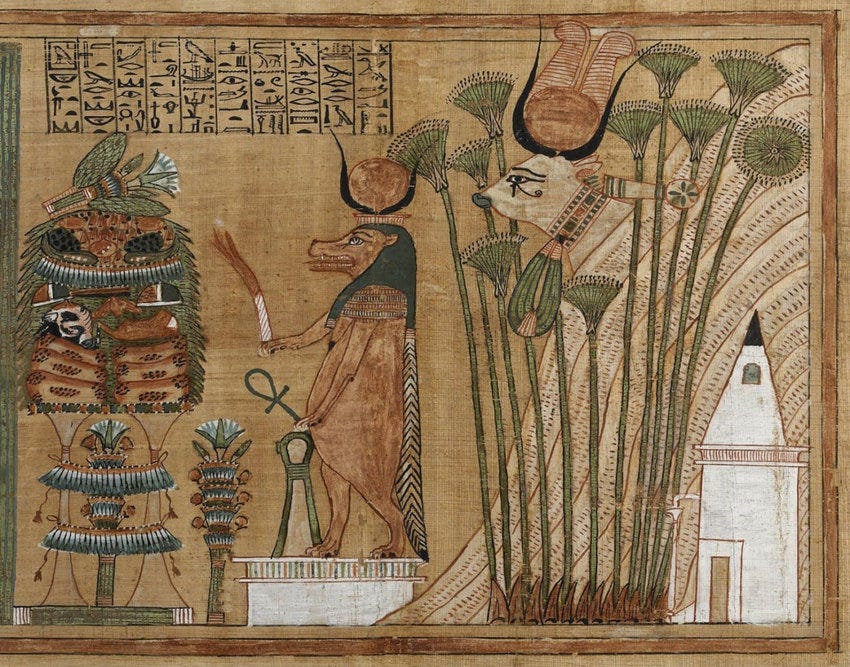
The ancient Egyptian goddess Hathor in the shape of a cow descending into the papyrus marshes from a stylised mountain, and a hippopotamus goddess with lotus/water lily offerings. From the Book of the Dead on the Papyrus of Ani, c. 1250 BCE. British Museum, London.
Hathor was also said in some myths to be mother to Ptah, the creator and fertility god associated with the sacred bull, Apis. Apis was also linked to Osiris, the god of the underworld, death, and rebirth—this theme of the bull and resurrection repeats time and time again.
Back to Hathor, she was considered to be the mother or “queen of heaven”—yet she was not the first, at least in the written record, referred to by this name.** The first example of a divine figure participating in a descent to the underworld and subsequent resurrection was not male - but female. She is connected with the first written story of a “bull of heaven” and her name is Inanna.
The Original Descent
Taurus marked the vernal point, the spring equinox horizon line, at the height of goddess worship in Sumeria, Mesopotamia, and the Aegean, from about 4000 BC to 1700 BC. Although the prominence of the bull predates the Age of Taurus (by tens of thousands of years), Inanna is the original goddess, the archetype, the story, the essence from which all other goddesses descend across religious traditions, at least from Mesopotamia westward.
The Babylonian version of Inanna and the bull of heaven is the most well-known, due to being written later and better preserved in the Epic of Gilgamesh the giant, who was associated with the constellation Orion.
In this version, Ishtar (Babylonian version of Inanna) sends the Bull of Heaven to kill Gilgamesh because of his “rejection of her amorous advances.” In retaliation, Ishtar complains to her mother Antu and father Anu, demanding they send the Bull—or else she will bring up the dead from the underworld. Anu, her father, releases the bull who kills 300 men before Enkidu, Gilgamesh’ friend, kills the bull, leading to the bull’s memorialization in the constellation of Taurus.
Yet, this later version of the story has been twisted to demonize the goddess.
“According to Falkenstein, the Sumerian Gilgamesh and the Bull of Heaven may have had an entirely different beginning from the episode in the Akkadian versions.” - Jeffrey H. Tigay
A poem in its Sumerian form, Inanna does not propose to Gilgamesh and she does not threaten her father Anu. Scholars believe, based on the fragments we have of this earlier version, Inanna “simply threatens to cry out and when she does, her cry reaches heaven and earth and An becomes frightened.”
A (possible) translation: Anu overreacts to Inanna’s feminine display of emotion, not knowing what do, sends the Bull of Heaven.
Even in the Babylonian version of the story, the goddess directs the power of the masculine bull, her divine father Anu, and the warrior giant Gilgamesh.
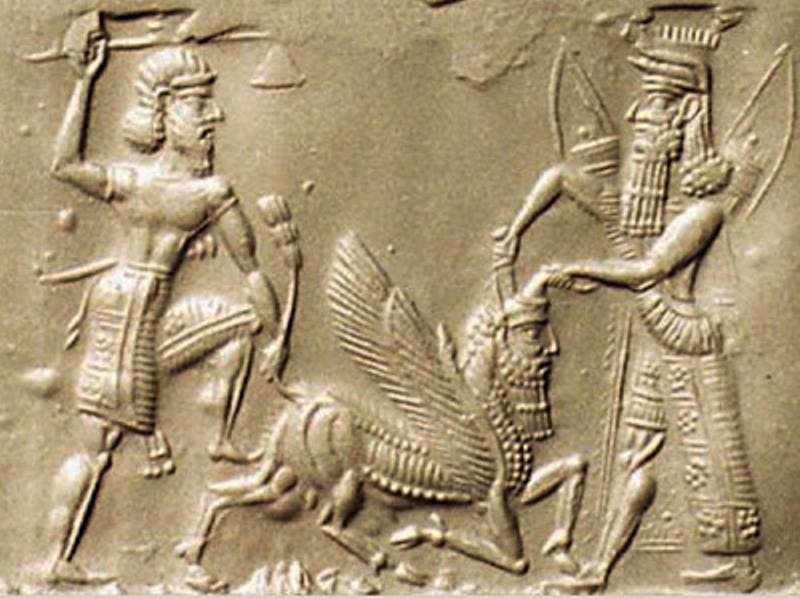
Gilgamesh & Enkidu kill the bull of heaven
“In many ways the Bull of Heaven’s impetuous, forceful, procreative character resembles Inanna’s.” - Samuel Noah Kramer
This is one of many tales on Inanna, her most essential being “The Descent of Inanna,” a very ancient poem that details the goddesses trip to the underworld that is filled with symbology and meaning echoed in spiritual stories and teachings for centuries to come. I will explore this in the future, but for now know that Inanna, her relationship to the bull, her position of power, and her embodiment of the theme of resurrection as a goddess, rather than a god, is a lynchpin of spiritual history.
To circle back to the bull, the theme found in this story—and then in many more such as the Greek with Europa—is that the goddess is the initiator of the bull’s power. She holds space for his transformation and facilitates his rebirth.
Bull and the Sky God
I would be remiss not to mention the association of the bull and the sky gods, an universal archetype of divinities found across (earthly) space and time. I wrote an entire piece on the Sky Gods back in 2021 you can read here. In essence, this is a class or category of gods who are not the first or the creators of earth, though sometimes they do create humanity.
These masculine divinities share symbols from lightening bolts, thunder, and rain, to characteristics such as ruling to create law and order, often with an iron fist. What they most remarkably share in common is a story of ascension to the divine “throne”— again and again this is the divnity that becomes teh supreme being, “usurping” the creator Father god. I explore this more in depth in my 2022 essay, Searching for the Most High.
Alongside the symbol of the stormy sky, these divinities are often connected with the bull. Zeus, Greek sky god, transforms himself into a bull to seduce Europa—this type of story was a common way to explain the conquest and integration of goddess-based Aegean cultures by the expanding Greek empire.
“The tendency on the part of the Indo-European deities when they would come in with the warrior folk would be for the male deities to marry the local female goddesses. This is one reason why Zeus had so many adventures.” - Joseph Campbell
Even in the tradition of the ancient Israelites, archeological evidence links bull-related sacred sites and archeological facts with Yahweh and El—the Canaanite lead god who was head of that pantheon and would have been worshiped before Yahweh took center stage.
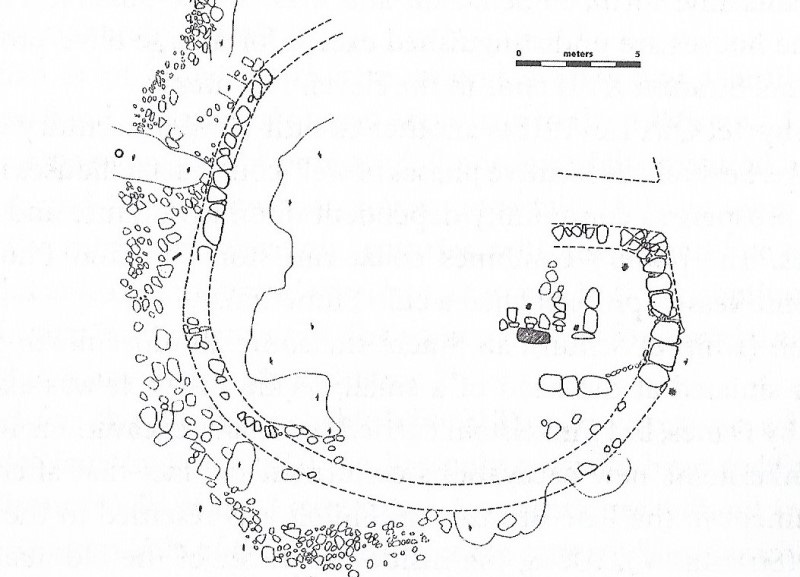
The Bull Site, Dhahrat et-Tawileh, in Samaria, 12th cent. B.C.E.
I don’t believe in clinging to a linear trajectory of time, but it strikes me that the Age of Taurus waned in 1700 BC, right when the masculine paradigm of religion and spirituality rose in Mesopotamia - which then cascaded across the earth in the following 2,000 years through Judeo-Christianity.
It cannot be denied that long before the bull was the symbol of these powerful sky gods, it was intricately connected to the goddess, who was perceived to have facilitated the bull’s birth and resurrection.
A Rise in Feminine Consciousness
Remembering that the Bull marked the vernal point (spring equinox) at the time of Inanna 4000 BCE, it fascinates me that now the bull is inching towards marking the dawn horizon at summer solstice.
Currently, the Western astrologers will tell you the Sun is in Cancer at the time of the summer solstice, but in truth the sun is in Gemini in the sky itself, having moved over the midpoint line into that constellation a day prior. Due to precession, how the wobble of the earth on it axis changes our orientation to the sky, in the future, the Sun will be in the very last degrees of Taurus during the summer solstice.
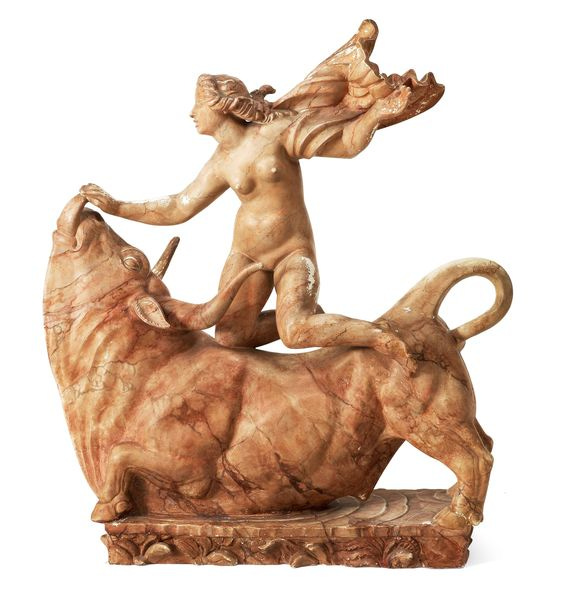
Europa and the bull
This is significant because the solstice marks the beginning of the days shortening, the sun’s descent, and therefore this date would have been tied to the same concepts of death and resurrection as the bull.
You can think of it as an alignment of the celestial bodies and ancient allegory - perhaps this event on the horizon is part of the celestial energy calling us into this reawakening of true sky astrology and the lost myths of the goddesses.
This is by no means an exhaustive survey of the bull across antiquity, but a revival of forgotten themes that bring to the surface of our consciousness the connection between facing our deepest shadows and greatest fears—death—and the power found in resurrection.
The goddess holds space for it all, and maybe that’s the hope that we’re missing in today’s culture and consciousness where we have forgotten her power.
Notes:
*In my opinion, “Pluto” mythology of the underworld’s connection to the planet Pluto is up for grabs given (the planet) was named by a child in the early 20th century after Mickey Mouse’ dog. More on scorpio and Pluto here.
**Written records are simply what we have to go with in terms of dating the “oldest” stories, but the entire paradigm of relying on the written word is misleading. Oral traditions are well known to be reliable for thousands if not tens of thousands of years, according to anthropologists. When it comes to Inanna, she is just the first written record of the Queen of Heaven, which I would say is the original creator goddess worshiped across many cultures, with her energy staying the same and only her name and details changing. I discuss written vs. oral history more deeply on the Ancient Future Heart podcast episode titled, “What is Myth?”
Sources:
Joseph Campbell, The Masks of God, Complete Anthology.
Joseph Campbell, Goddess: Mysteries of the Feminine Divine.
Mircea Eliade, Patterns in Comparative Religion.
https://www.penn.museum/collections/highlights/neareast/puabi.php
https://www.thetorah.com/article/the-golden-calf-bull-el-worship